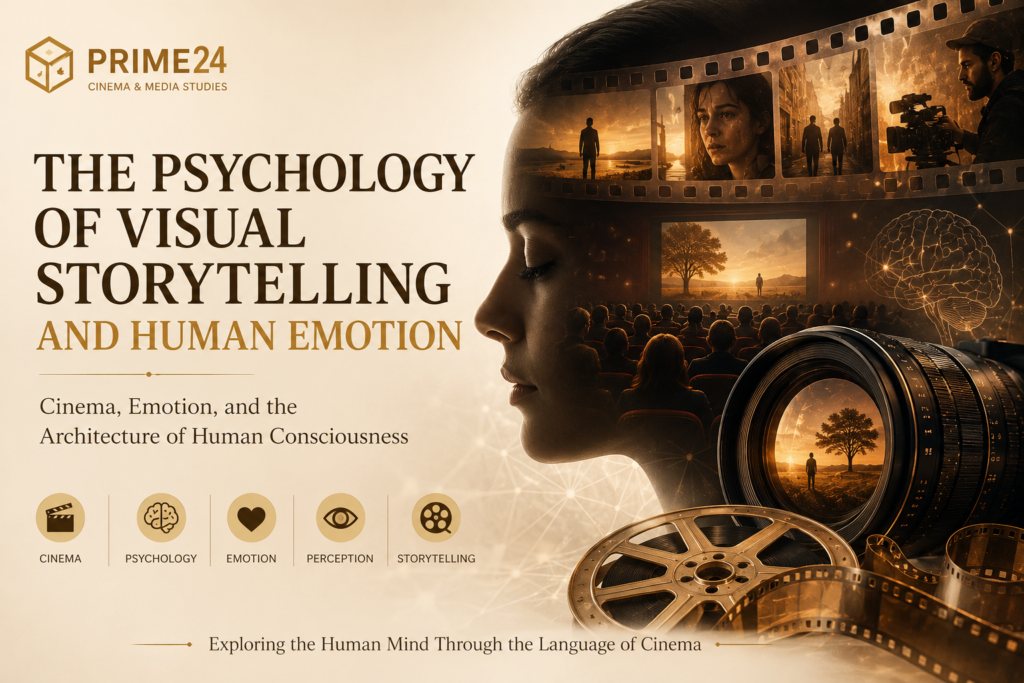
Cinema, Emotion, and the Architecture of Human Consciousness
Introduction
Why do certain cinematic scenes remain deeply embedded in human memory for decades?
Why can a piece of music, a silent close-up, or a single visual moment generate emotional reactions stronger than pages of written explanation?
Why do audiences cry for fictional characters, emotionally connect with distant societies, or feel psychologically immersed within stories they know are not real?
The relationship between visual storytelling and human emotion represents one of the most profound dimensions of cinema and media throughout modern history.
Human beings do not experience stories solely through logic or information. They experience them emotionally, psychologically, and symbolically. The human mind naturally responds to narrative structure, visual rhythm, facial expression, sound, atmosphere, and emotional tension in ways that shape perception, memory, empathy, and personal interpretation.
Cinema transformed storytelling into a uniquely immersive human experience by combining image, movement, music, sound, color, silence, editing, and emotion within a single visual language capable of directly influencing consciousness.
Unlike written communication alone, visual storytelling engages multiple psychological and emotional systems simultaneously. Through cinematic language, audiences do not simply observe stories — they emotionally inhabit them.
Over time, filmmakers, psychologists, neuroscientists, and media theorists increasingly explored the connection between visual storytelling and the architecture of human consciousness. Research in psychology and cognitive science suggests that emotionally charged visual experiences are often processed and remembered differently from abstract information alone.
This helps explain why certain films, documentaries, photographs, and visual narratives become deeply connected to collective memory and emotional identity across societies and generations.
Documentary cinema occupies a particularly important position within this relationship because it combines emotional storytelling with real human experiences, historical testimony, and lived reality. Through documentary storytelling, audiences frequently develop emotional awareness toward people, cultures, and historical experiences beyond their immediate environment.
In the digital era, where billions of images and visual narratives circulate continuously across streaming platforms and social media environments, understanding the psychology of visual storytelling has become increasingly important.
Visual communication no longer functions only as entertainment or information delivery. It increasingly shapes:
emotional response,
attention,
empathy,
memory,
identity,
and collective consciousness itself.
This study explores the psychological foundations of visual storytelling and examines how cinema, documentary filmmaking, and visual media influence human emotion, perception, empathy, memory, and social awareness through the language of images and cinematic narrative.
Storytelling and Human Consciousness
Storytelling is one of the oldest foundations of human civilization.
Through stories, societies were able to:
preserve memory,
transmit values,
interpret the world,
and strengthen collective identity.
Human beings do not naturally connect with isolated information alone. Instead, they respond more deeply to:
characters,
emotions,
conflict,
transformation,
and human meaning.
For this reason, storytelling remained a central element in:
education,
culture,
philosophy,
religion,
and media throughout history.
Cinema later transformed storytelling by giving it an unprecedented visual and emotional dimension.
Moving images do not merely communicate information. They allow audiences to psychologically and emotionally experience events, environments, and human realities through immersive visual language.
This transformation made visual storytelling one of the most influential forms of communication in modern society.
Unlike traditional written narratives, cinema combines:
image,
sound,
movement,
atmosphere,
rhythm,
and emotional pacing within a unified sensory experience capable of directly influencing perception and emotional engagement.
As visual storytelling evolved, cinema increasingly became connected not only to entertainment, but also to:
emotional memory,
cultural identity,
social understanding,
and the construction of collective consciousness.
Documentary cinema further expanded this role by connecting storytelling with reality, historical testimony, and lived human experience.
Through documentary narratives, audiences often develop emotional awareness toward societies, historical moments, and human experiences beyond their personal environment.
This relationship between storytelling and consciousness helps explain why visual narratives continue to shape the way individuals and societies understand:
history,
identity,
emotion,
and the human condition itself.
Emotion as the Core of Visual Communication
Emotion plays a central role in cinematic language.
Audiences often remember how a film made them feel more than the exact details of dialogue or narrative structure.
Visual storytelling influences emotion through multiple interconnected elements:
facial expression,
lighting,
color,
camera movement,
music,
sound design,
editing rhythm,
pacing,
and visual symbolism.
Even subtle cinematic choices can influence emotional interpretation.
Warm lighting may create feelings of intimacy or nostalgia. Slow pacing may encourage contemplation. Music can intensify emotional response and shape audience expectation before dialogue even begins.
This emotional architecture explains why cinema often creates powerful psychological experiences capable of remaining in memory for years or even decades.
Documentary filmmaking uses many of these same emotional principles while focusing on real people, historical events, and lived experiences.
As a result, documentary cinema frequently strengthens emotional connection between audiences and social realities occurring beyond their immediate environment.
The Human Brain and Visual Memory
Modern neuroscience increasingly suggests that visual information plays a major role in how human memory functions.
The brain processes visual experiences rapidly and often stores emotionally significant images more effectively than abstract information alone.
This helps explain why historical photographs and documentary footage frequently become symbolic representations of entire historical periods.
Certain images remain deeply embedded within collective memory because they combine:
emotional intensity,
narrative context,
symbolic meaning,
and visual clarity.
Cinema amplifies this process by combining moving imagery with sound, pacing, and narrative structure.
The interaction between image and emotion strengthens memory retention and psychological engagement.
As a result, films and documentaries often influence not only what audiences know, but also how they emotionally interpret historical events, social issues, and human experiences.
Empathy and the Cinematic Experience
One of the most important psychological effects of visual storytelling is the creation of empathy.
Cinema allows audiences to observe experiences beyond their personal reality:
different cultures,
distant societies,
historical periods,
humanitarian experiences,
scientific journeys,
and personal struggles.
Through visual immersion, audiences may emotionally connect with individuals they have never met and environments they have never visited.
This emotional connection can expand social awareness and deepen understanding of human diversity.
Documentary storytelling is particularly important in this regard because it often introduces viewers to authentic voices, real testimonies, and lived realities.
Rather than presenting information abstractly, documentaries frequently humanize social issues through personal experience and emotional narrative.
This ability to strengthen empathy explains why documentary cinema remains important within:
education,
cultural dialogue,
humanitarian awareness,
and historical reflection.
Editing, Rhythm, and Psychological Engagement
Editing is one of the most powerful psychological tools within cinema.
The arrangement of images over time influences:
emotional rhythm,
attention,
suspense,
meaning,
and audience interpretation.
Soviet montage theory demonstrated how editing could create emotional and intellectual associations between images.
Modern cinematic editing continues to shape psychological engagement through rhythm and visual structure.
Fast editing may create tension, excitement, or urgency. Slow pacing may encourage emotional reflection or psychological depth.
The relationship between editing and human attention has become increasingly important in the digital era, where social media platforms and short-form video environments compete intensely for audience focus.
Visual rhythm therefore influences not only artistic storytelling, but also modern communication patterns themselves.
Color, Atmosphere, and Symbolic Language
Color psychology represents another important dimension of visual storytelling.
Throughout cinema history, filmmakers used color palettes to influence emotional atmosphere and symbolic meaning.
Different visual tones may evoke:
calmness,
tension,
warmth,
melancholy,
optimism,
mystery,
or reflection.
Visual symbolism also plays a major role in cinematic communication.
Objects, spaces, light, movement, and recurring visual patterns often carry symbolic associations that influence audience interpretation subconsciously.
Documentary cinema sometimes uses symbolism carefully to strengthen emotional resonance while maintaining narrative authenticity.
This symbolic dimension allows cinema to communicate complex emotional and philosophical ideas through visual language rather than direct explanation alone.
Digital Media and Emotional Saturation
The rise of digital media dramatically increased humanity’s exposure to visual storytelling.
Social media platforms, streaming services, mobile devices, and algorithmic recommendation systems now distribute enormous quantities of visual content every day.
This transformation changed not only media consumption, but also emotional experience itself.
Modern audiences frequently encounter:
rapid visual stimulation,
emotionally intensified content,
short-form storytelling,
and constant information flow.
While digital accessibility expanded global communication, it also introduced new psychological challenges related to:
attention fragmentation,
emotional fatigue,
information overload,
and reduced reflective engagement.
Visual storytelling in the digital age therefore exists within increasingly competitive attention environments shaped by algorithms and platform behavior.
Artificial Intelligence and Emotional Simulation
Artificial intelligence is beginning to influence emotional storytelling in new ways.
AI technologies can now assist in:
image generation,
voice synthesis,
visual enhancement,
editing,
recommendation systems,
and audience behavior analysis.
These developments may significantly transform future media production and cinematic communication.
However, they also raise important ethical and philosophical questions regarding emotional authenticity.
As AI-generated content becomes more sophisticated, societies may increasingly debate:
the difference between authentic and synthetic emotional experience,
the role of human creativity,
and the future relationship between technology and emotional storytelling.
The future of visual communication may therefore depend not only on technological innovation, but also on maintaining meaningful human connection within digital environments.
Conclusion
Visual storytelling remains one of the most powerful forms of human communication.
Cinema, documentary filmmaking, photography, and digital media influence how societies:
remember history,
experience emotion,
construct identity,
understand human experience,
and interpret reality itself.
The psychology of visual storytelling reveals that cinema is not merely entertainment or information delivery. It is also a psychological and emotional architecture capable of shaping empathy, memory, perception, and collective consciousness.
In the digital age, where visual communication increasingly dominates public life, understanding the emotional and psychological dimensions of media becomes essential for education, cultural awareness, and responsible communication.
Cinema & Media Studies at PRIME24 seeks to explore these evolving relationships through research, documentary analysis, visual studies, and educational content dedicated to understanding how storytelling, cinema, emotion, and visual communication continue shaping modern human consciousness.
PRIME24
Leave a Reply