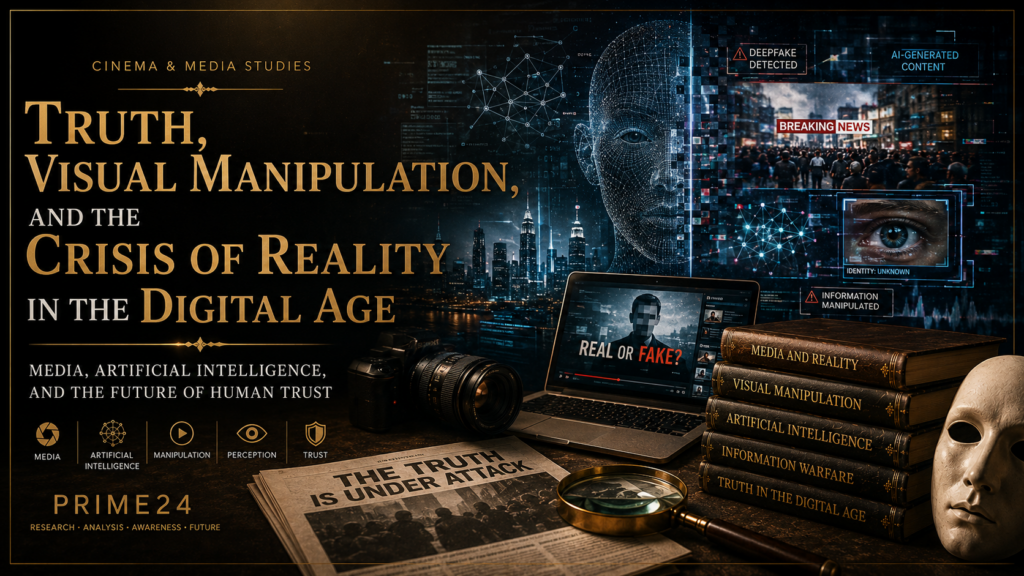
Media, Artificial Intelligence, and the Future of Human Trust
Introduction
Throughout modern history, societies relied heavily on visual media as a source of information, documentation, and public understanding. Photography, cinema, television, and documentary filmmaking were widely perceived as tools capable of recording reality and preserving evidence of historical events.
For decades, the phrase “seeing is believing” reflected humanity’s confidence in the authenticity of visual representation.
Images became powerful instruments in journalism, education, politics, diplomacy, scientific research, and collective memory. Historical photographs and documentary footage shaped how generations understood wars, revolutions, humanitarian crises, scientific achievements, and cultural transformation.
However, the rapid evolution of digital technologies, social media platforms, synthetic media, and artificial intelligence has fundamentally transformed humanity’s relationship with visual truth.
Today, images can be altered, reconstructed, generated, or simulated with unprecedented realism. Artificial intelligence systems are increasingly capable of producing synthetic photographs, realistic voices, manipulated videos, and digitally generated environments that may appear authentic to ordinary audiences.
This transformation introduces one of the most important questions of the twenty-first century:
How can societies preserve trust in visual reality within an era of infinite digital reproduction and synthetic media?
This study explores the growing crisis of visual authenticity in the digital age, examining the relationship between media, artificial intelligence, public trust, and the future of human perception.
The Historical Authority of the Image
Since the invention of photography in the nineteenth century, visual media acquired extraordinary authority within human societies.
Photographs were often viewed as objective records of reality. Cinema expanded this authority further by allowing audiences not only to observe static moments, but also to witness movement, emotion, action, and historical events unfolding visually.
Documentary cinema, television journalism, and live broadcasting strengthened public confidence in visual evidence.
Wars, political speeches, humanitarian disasters, space exploration, and social movements became part of global memory largely through visual documentation.
The twentieth century therefore became the first era in which humanity could visually archive history on a massive scale.
This visual revolution deeply influenced collective consciousness.
Images no longer merely illustrated reality — they increasingly defined it.
The Digital Transformation of Media
The emergence of digital technology radically transformed the production and distribution of visual content.
Traditional media institutions once controlled much of the global information flow through newspapers, television networks, radio stations, and film studios.
Digital platforms disrupted this structure.
The rise of smartphones, social networks, streaming platforms, and instant publishing systems allowed billions of individuals to create and distribute visual content globally within seconds.
Information became faster, more decentralized, and more accessible than at any previous moment in human history.
At the same time, the boundaries between professional journalism, entertainment, advertising, personal expression, and algorithmic distribution became increasingly blurred.
Modern audiences are now exposed to enormous quantities of visual information every day:
short videos,
livestreams,
edited content,
algorithmically recommended media,
and AI-assisted imagery.
This transformation dramatically accelerated the speed at which public perception can be influenced or reshaped.
Algorithms and the Construction of Perception
Digital platforms do not simply distribute information neutrally.
Algorithms increasingly determine:
what people watch,
what trends become visible,
which narratives gain attention,
and how audiences emotionally interact with content.
Recommendation systems analyze human behavior, preferences, attention patterns, and engagement metrics in order to maximize user interaction.
As a result, modern media environments are heavily shaped by algorithmic logic rather than chronological or editorial structure alone.
This has profound consequences for public perception.
Individuals often encounter highly personalized information ecosystems where exposure to content is influenced by behavioral prediction systems.
Visual communication therefore becomes connected not only to storytelling, but also to data analysis, attention engineering, and psychological engagement.
The architecture of perception itself becomes partially mediated by algorithms.
Artificial Intelligence and Synthetic Reality
Artificial intelligence represents one of the most transformative developments in the history of visual communication.
AI technologies are now capable of:
generating realistic images,
synthesizing human voices,
creating artificial video,
reconstructing historical footage,
simulating environments,
and automating visual production.
These technologies offer extraordinary creative and educational possibilities.
Artificial intelligence can assist:
filmmakers,
archivists,
historians,
educators,
journalists,
and researchers.
It can help restore damaged historical footage, improve accessibility, automate translation, and expand creative storytelling methods.
However, synthetic media technologies also create new challenges regarding authenticity and trust.
Deepfake systems, manipulated video, AI-generated imagery, and synthetic speech can blur the distinction between documentation and fabrication.
For the first time in modern history, visual evidence itself becomes increasingly difficult to verify through ordinary observation alone.
This represents a major transformation in the relationship between media and reality.
The Crisis of Visual Trust
Modern societies depend heavily on trust in information systems.
Journalism, documentary archives, historical records, educational institutions, and democratic communication all rely to some degree on shared confidence in the credibility of evidence.
When visual authenticity becomes uncertain, broader social consequences emerge.
The inability to distinguish authentic documentation from synthetic manipulation may contribute to:
confusion,
misinformation,
erosion of public trust,
polarization,
and growing skepticism toward institutions and media systems.
The challenge is therefore not only technological, but also cultural and philosophical.
Societies increasingly face questions such as:
What defines visual truth?
How should authenticity be verified?
Can digital evidence remain trustworthy?
What ethical standards should govern AI-generated media?
These questions may become central to the future of journalism, documentary filmmaking, education, law, and historical preservation.
Documentary Cinema in the Age of AI
Documentary cinema now enters a new historical phase.
Traditionally, documentaries were associated with observation, testimony, historical evidence, and visual reality.
In the era of synthetic media, documentary filmmakers must increasingly address issues of verification, transparency, and ethical responsibility.
This does not mean that artificial intelligence necessarily threatens documentary cinema itself.
On the contrary, AI may become an important tool for:
archival restoration,
multilingual accessibility,
visual reconstruction,
educational visualization,
and cinematic research.
The challenge lies in maintaining clear ethical boundaries between:
reconstruction and fabrication,
interpretation and deception,
enhancement and manipulation.
The future credibility of documentary filmmaking may depend on transparent production standards capable of preserving audience trust while embracing technological innovation.
Media Literacy and Human Awareness
As media environments become more complex, media literacy becomes increasingly important.
Modern audiences require not only access to information, but also the ability to critically analyze visual content, identify manipulation, understand algorithms, and evaluate sources responsibly.
Media literacy is no longer limited to journalism education alone.
It has become an essential cultural skill for navigating digital civilization.
Educational institutions, media organizations, filmmakers, and cultural platforms increasingly play an important role in promoting critical awareness regarding digital communication and synthetic media.
Human consciousness itself must adapt to environments where visual reality becomes technologically fluid.
Artificial Intelligence and the Future of Human Perception
The future relationship between artificial intelligence and human perception remains one of the defining questions of the twenty-first century.
AI systems increasingly influence:
communication,
entertainment,
education,
political messaging,
cultural production,
and information distribution.
As these technologies evolve, humanity may gradually enter an era where synthetic and authentic experiences coexist continuously within digital environments.
This transformation may reshape:
memory,
identity,
emotional experience,
and collective understanding of reality itself.
The future of visual communication will therefore depend not only on technological progress, but also on ethical responsibility, educational awareness, institutional transparency, and cultural adaptation.
Conclusion
The digital revolution and the rise of artificial intelligence have transformed visual communication more rapidly than any previous period in modern history.
Photography, cinema, television, and digital media once strengthened humanity’s ability to document reality and preserve historical memory. Today, synthetic media technologies challenge traditional assumptions surrounding authenticity and visual evidence.
The crisis of visual trust represents one of the most important cultural and intellectual challenges of the contemporary world.
Yet technological transformation also creates opportunities for innovation, education, restoration, accessibility, and global communication.
The future of media may therefore depend on humanity’s ability to balance technological advancement with ethical responsibility and critical awareness.
Cinema & Media Studies at PRIME24 seeks to explore these transformations through documentary analysis, media research, visual studies, and educational content dedicated to understanding how digital media, artificial intelligence, and visual communication continue shaping human consciousness and the future of civilization.
PRIME24
Leave a Reply