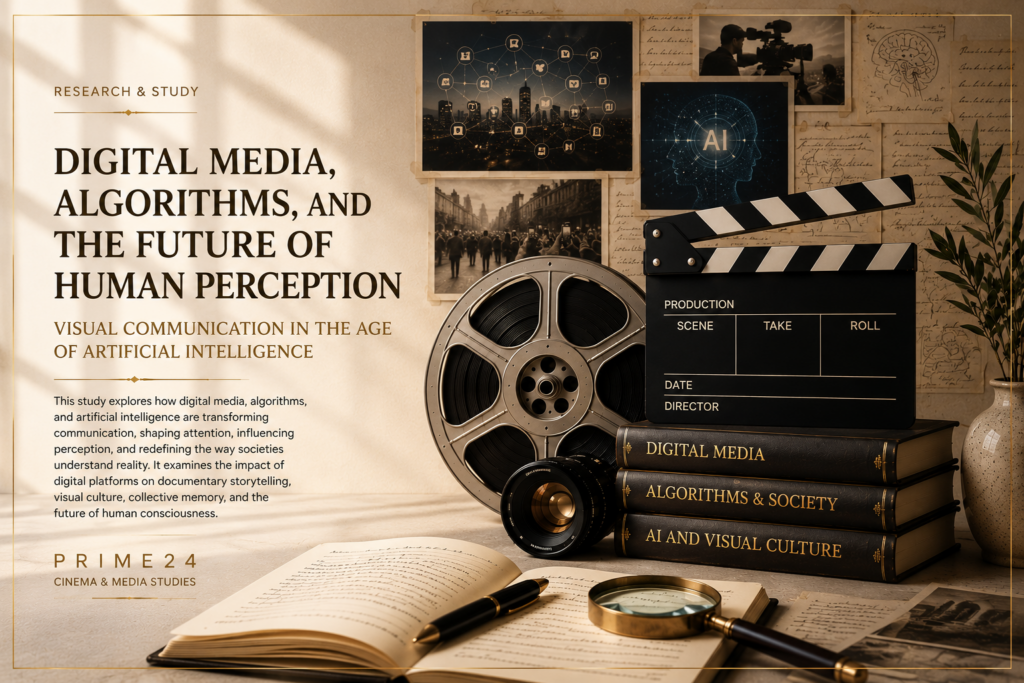
Visual Communication in the Age of Artificial Intelligence
Introduction
The twenty-first century has witnessed one of the most profound transformations in the history of human communication. While cinema, television, radio, and print media shaped the industrial age of information, digital technologies introduced an entirely new communication environment built upon speed, algorithms, interconnected platforms, and constant visual interaction.
Today, billions of people experience reality through screens. News, political events, education, entertainment, cultural trends, and even personal identity are increasingly mediated through digital images and algorithmic systems capable of influencing what individuals see, remember, and emotionally engage with.
This transformation has fundamentally altered the relationship between media and human perception. Visual communication is no longer limited to traditional broadcasting institutions or cinematic studios. Digital platforms, streaming services, social networks, smartphones, and artificial intelligence systems have decentralized the production and circulation of images on a global scale.
As a result, media has evolved from a system of information delivery into an environment that continuously shapes attention, emotion, memory, behavior, and social awareness.
This study explores the evolution of digital media and examines how algorithms, visual culture, and artificial intelligence are redefining communication, documentary storytelling, and the future of human perception.
From Mass Media to Digital Ecosystems
For much of the twentieth century, communication operated through centralized institutions. Newspapers, television channels, radio stations, and film studios controlled the production and distribution of information.
Audiences largely consumed media passively through scheduled programming and nationally regulated broadcasting systems.
The digital revolution transformed this structure entirely.
The rise of the internet introduced a decentralized communication environment where information could circulate instantly across borders and platforms. The emergence of social networks accelerated this transformation by turning individuals themselves into active participants within global media systems.
Platforms such as YouTube, digital streaming services, online publications, podcasts, and visual-sharing networks created a communication ecosystem in which billions of images, videos, and narratives are exchanged daily.
The audience was no longer merely a spectator. Users became creators, publishers, commentators, and distributors of visual content.
This transformation fundamentally changed the speed, scale, and psychological influence of modern communication.
Algorithms and the Architecture of Attention
One of the defining characteristics of modern digital media is the rise of algorithmic communication systems.
Unlike traditional media institutions where editors selected content manually, digital platforms increasingly rely on algorithms capable of organizing information according to user behavior, engagement patterns, interests, and viewing habits.
Algorithms determine which videos appear, which topics trend, which images gain visibility, and which narratives dominate public attention.
As a result, modern communication is no longer shaped solely by journalists, filmmakers, or broadcasters. It is increasingly shaped by invisible computational systems designed to maximize interaction and audience retention.
This has created what many researchers describe as an “attention economy,” where visibility itself becomes one of the most valuable forms of digital influence.
The structure of online platforms encourages rapid emotional engagement, visual immediacy, and continuous information consumption.
Consequently, visual storytelling today operates within environments optimized not only for communication, but also for behavioral interaction.
The Transformation of Documentary Storytelling
Digital technologies have profoundly transformed documentary filmmaking itself.
Traditional documentaries once depended heavily on television networks, film institutions, national broadcasters, or theatrical distribution systems. Today, independent filmmakers and researchers can publish documentaries globally through digital platforms.
This democratization of distribution has expanded access to visual storytelling across cultures and societies.
Documentary cinema has also evolved stylistically in response to digital viewing habits. Contemporary audiences increasingly consume visual narratives through shorter formats, streaming platforms, mobile devices, and interactive media environments.
As a result, modern documentary storytelling often combines cinematic language with digital pacing, archival material, visual graphics, data visualization, and cross-platform communication strategies.
Streaming services further transformed documentary filmmaking into a global cultural phenomenon. Documentaries addressing environmental issues, historical memory, science, politics, technology, migration, and social transformation now reach audiences across continents almost instantly.
This global accessibility has strengthened documentary cinema’s role as a medium for education, awareness, cultural dialogue, and historical reflection.
Artificial Intelligence and Synthetic Media
Artificial intelligence represents one of the most significant developments in the history of visual communication.
AI technologies are increasingly capable of generating images, editing video, translating speech, enhancing archival footage, automating subtitles, restoring historical recordings, and assisting creative production.
These tools are rapidly transforming filmmaking, journalism, visual education, and media production.
At the same time, artificial intelligence introduces important ethical and philosophical questions regarding authenticity, visual credibility, and public trust.
Synthetic media technologies now make it possible to create realistic digital imagery capable of simulating voices, environments, and human appearance with remarkable precision.
This development challenges traditional assumptions surrounding documentary evidence and visual truth.
Throughout history, photography and cinema were often perceived as direct recordings of reality. In the AI era, however, visual authenticity increasingly requires verification, transparency, and media literacy.
The future of documentary filmmaking may therefore depend not only on technological innovation, but also on the preservation of ethical standards capable of maintaining public trust in visual communication.
Social Media and the Fragmentation of Collective Experience
One of the most important consequences of digital communication is the fragmentation of collective media experience.
During the twentieth century, television broadcasts and cinema screenings often created shared national or global moments experienced simultaneously by large audiences.
Digital platforms, however, personalize information flows according to individual behavior and algorithmic recommendations.
As a result, people increasingly experience different versions of reality shaped by personalized media environments.
This transformation influences political awareness, cultural identity, historical interpretation, and social dialogue.
Visual communication no longer functions only as a shared public experience. It increasingly operates as an individualized stream of images, narratives, and emotional interactions.
This raises important questions regarding collective memory, social cohesion, and the future of public communication in digitally fragmented societies.
Digital Archives and the Preservation of Human Memory
Despite these challenges, digital technologies have also expanded humanity’s capacity to preserve visual memory.
Archives, documentaries, historical recordings, photographs, oral testimonies, and cultural heritage materials can now be digitized and shared globally.
Educational institutions, documentary filmmakers, museums, libraries, and media organizations increasingly rely on digital preservation systems to protect historical memory for future generations.
Streaming archives and online educational platforms allow audiences to access historical documentaries, rare footage, and visual records previously limited to specialized institutions.
In this sense, digital media simultaneously transforms and preserves human memory.
The future of visual culture may therefore depend on balancing technological innovation with responsible preservation of historical authenticity and cultural understanding.
Conclusion
Digital media has fundamentally transformed the structure of modern communication.
Algorithms, streaming platforms, artificial intelligence, and global digital networks now shape how societies receive information, interpret reality, and construct collective awareness.
Documentary filmmaking continues to play a central role within this transformation because it combines visual storytelling with historical reflection, education, and cultural interpretation.
However, the rise of synthetic media, algorithmic influence, and fragmented communication environments also introduces significant ethical and intellectual challenges regarding truth, memory, and public trust.
The future of visual communication will likely depend not only on technological progress, but also on humanity’s ability to preserve critical thinking, media literacy, and ethical responsibility within increasingly digital societies.
Cinema & Media Studies at PRIME24 seeks to examine these transformations through historical research, documentary analysis, visual studies, and educational initiatives dedicated to understanding the evolving relationship between technology, perception, and human consciousness in the digital age.
PRIME24
Leave a Reply