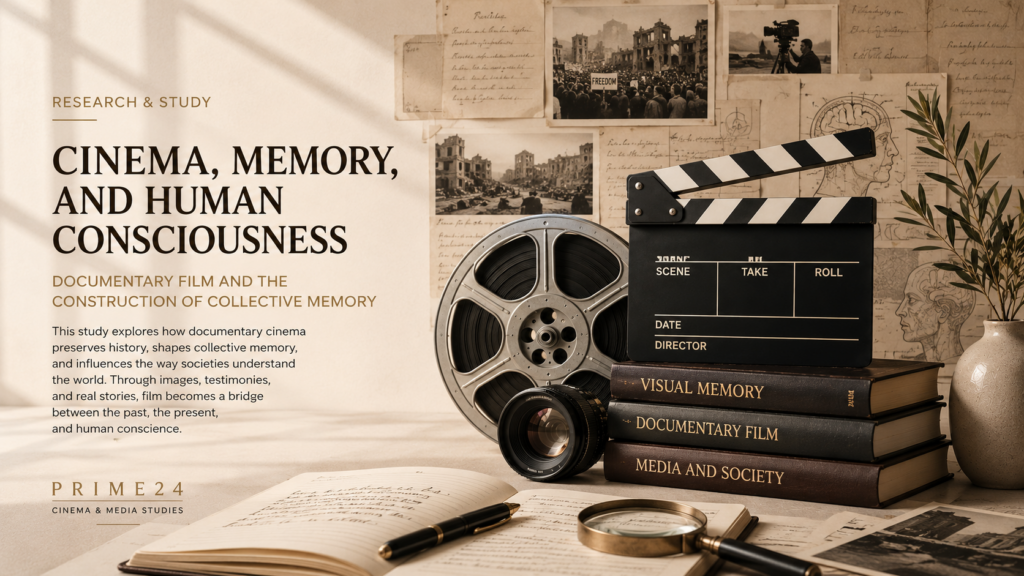
Cinema, Memory, and Human Consciousness
Documentary Film and the Construction of Collective Memory
Introduction
Since the earliest stages of human civilization, memory has represented one of the most powerful foundations of collective identity and cultural continuity. Long before written history, societies relied on oral storytelling, symbols, rituals, cave paintings, and myths to preserve experiences and transmit knowledge across generations. Human beings continuously searched for methods capable of protecting memory from disappearance and transforming lived experience into shared historical consciousness.
With the emergence of photography in the nineteenth century, humanity witnessed the first technological ability to visually preserve reality. For the first time in history, moments could survive beyond the limitations of time and human recollection. Yet photography alone remained a frozen fragment of reality. The invention of cinema transformed memory itself into motion.
Moving images introduced a revolutionary form of communication capable of combining narrative, sound, emotion, symbolism, space, and time into a unified human experience. Cinema became more than a technological invention; it evolved into one of the most influential instruments in shaping modern consciousness and collective perception.
Over the twentieth century, documentary filmmaking emerged as one of the most significant forms of visual memory. Unlike fictional cinema, documentary films sought to observe reality, interpret historical events, preserve testimonies, and explore the relationship between individuals, societies, politics, and historical transformation.
Today, documentary cinema represents one of the primary methods through which humanity understands wars, revolutions, migrations, ideologies, identities, environmental crises, and cultural change. In many cases, visual archives and documentaries have become more influential than written history itself.
The Birth of Visual Memory
The origins of documentary filmmaking can be traced back to the experiments of the Lumière brothers in France during the late nineteenth century. Their early short films, such as workers leaving factories and trains arriving at stations, may appear simple by modern standards, yet they represented a historic transformation in the relationship between humanity and reality.
For the first time, ordinary life became recordable, reproducible, and shareable across societies. Cinema introduced the possibility of preserving human existence visually and emotionally rather than merely describing it through text.
These early visual recordings established the foundations of modern visual memory. Human beings no longer depended solely on historians, writers, or oral narratives. The camera itself became a witness.
As cinema evolved technologically, filmmakers began exploring editing, narrative sequencing, symbolism, and emotional construction. The moving image gradually transformed from passive observation into an active language capable of shaping interpretation and meaning.
Documentary Cinema and Historical Interpretation
Documentary cinema never functioned as a neutral mirror of reality. Every documentary involves choices related to framing, editing, narration, perspective, rhythm, and visual emphasis. Consequently, documentary filmmaking became both a recording tool and an interpretive instrument.
Throughout the twentieth century, different cinematic schools contributed to redefining how societies understood reality through images.
The Soviet montage school, led by filmmakers such as Sergei Eisenstein, demonstrated that editing itself could shape emotional and political meaning. Images placed together could generate ideological interpretation beyond the content of individual shots.
German cinema explored the relationship between visual language, nationalism, propaganda, and mass psychology during periods of political transformation.
British documentary pioneers such as John Grierson introduced documentary filmmaking as a social and educational project designed to strengthen public awareness and civic understanding.
In the United States, cinema and television gradually evolved into major instruments of cultural influence and global soft power. Hollywood, television networks, and later digital streaming platforms transformed visual storytelling into one of the most influential industries in modern history.
As a result, documentary filmmaking became deeply connected to questions of truth, power, representation, identity, and historical legitimacy.
Cinema and Collective Consciousness
One of the most important dimensions of documentary cinema lies in its ability to construct collective consciousness.
Entire generations often remember historical events not through direct experience, but through images repeatedly reproduced by media institutions and documentary archives. Wars, revolutions, political speeches, social movements, disasters, and cultural transformations become embedded within public memory through visual repetition.
The relationship between cinema and memory therefore extends beyond entertainment. Visual storytelling contributes to shaping emotional perception, national narratives, and collective identity.
A single documentary image can influence how societies remember an event for decades. In many cases, documentaries become historical references themselves, influencing education, journalism, academic research, and political discourse.
This phenomenon became increasingly powerful with the rise of television broadcasting during the twentieth century and later with digital media and online streaming platforms in the twenty-first century.
Today, millions of individuals experience global events simultaneously through visual media. The image has become one of the primary foundations of modern consciousness.
Digital Media and the Transformation of Documentary Storytelling
The digital revolution fundamentally transformed documentary filmmaking and visual communication.
Traditional barriers related to production costs, film distribution, and broadcasting infrastructures gradually disappeared. Digital cameras, editing software, online platforms, and mobile technologies democratized visual storytelling and allowed independent filmmakers to reach global audiences.
Streaming platforms accelerated the global expansion of documentary cinema by making educational and investigative content accessible across borders and cultures.
Simultaneously, social media introduced new forms of short-form visual narratives capable of influencing public opinion in real time. The distinction between journalism, documentary filmmaking, digital activism, and visual communication became increasingly interconnected.
Artificial intelligence now represents a new stage in the evolution of visual communication. AI-generated imagery, synthetic media, algorithmic recommendation systems, and automated editing technologies are beginning to reshape how visual narratives are produced, distributed, and consumed.
These developments raise profound philosophical and ethical questions concerning truth, manipulation, authenticity, and the future of visual memory itself.
Cinema, Ethics, and Human Responsibility
As visual communication becomes increasingly influential, ethical responsibility becomes more critical than ever.
Documentary filmmakers and media institutions possess significant power in shaping perception and public understanding. The selection of images, narratives, voices, and perspectives can influence political attitudes, social emotions, historical interpretation, and cultural identity.
For this reason, documentary filmmaking cannot be separated from ethical responsibility.
Questions surrounding truth, representation, manipulation, propaganda, and emotional influence remain central to modern media studies.
The challenge facing contemporary visual culture lies not only in technological development, but also in preserving human integrity within systems increasingly driven by speed, algorithms, and information overload.
In this context, documentary cinema continues to serve as one of the few visual forms capable of encouraging reflection, historical awareness, empathy, and critical thinking.
Conclusion
Cinema and documentary filmmaking transformed humanity’s relationship with memory, history, and consciousness.
From the earliest photographic experiments to the rise of digital streaming and artificial intelligence, visual communication evolved into one of the defining forces of modern civilization.
The moving image no longer functions merely as entertainment. It has become a cultural archive, a political instrument, an educational platform, and a mechanism through which societies understand themselves and interpret the world around them.
In the twenty-first century, the study of cinema and media is no longer limited to artistic analysis. It has become essential for understanding power, identity, memory, technology, and the future of human perception itself.
Cinema & Media Studies at PRIME24 seeks to explore these transformations through historical research, documentary analysis, visual culture studies, and educational content dedicated to examining the evolving relationship between image, society, and human consciousness.
PRIME24